
How to Celebrate the Traditional 40 Days of Christmas
5 Tips for keeping the 12 Days of Christmas and Beyond
In American culture, Christmas seems to be over December 26. The lights come down, people stop saying “Merry Christmas!”, and the trees find their way to the curb. The bleak midwinter of January hits but none of the Christmas cheer promised in songs of old remains for it.
Unless you’re Catholic. The cozy fall days have their fill through November, the month of Hallowtide and Poor Souls. The Advent fast takes over from there and when December 25 comes, we are more than ready to let the warm glow of the Christmas season carry us through the cold dark January nights. The merriment has just begun.
How long is the traditional Christmas season?
In the liturgical year, Christmas begins with the Feast of the Nativity (December 25) and ends with the Purification of the Blessed Virgin Mary (February 2)—it stretches from Christmas to Candlemas.
That’s a whole 40 days! As the great liturgist, Dom Guéranger, explains, “the custom of keeping this holy and glorious period of forty days as one continued Festival has every appearance of being a very ancient one.” Let us not forget it now!
But what are the 12 Days of Christmas?
Growing up, I was always confused about the 12 Days of Christmas. Each department store would advertise its “12 Days of Christmas sale” earlier and earlier each year. Perhaps even the same store would have multiple 12-day sales, leaving me to wonder when on earth the 12 days of Christmas actually were. It is no surprise that people often think it’s the 12 days leading up to Christmas.
The distinct idea of the “12 Days of Christmas” appears to be a northern European (English/Irish) cultural tradition reaching back to Tudor England. It’s a way of referring to the rich feast days that span the time from Christmas Day until the Eve of the Epiphany. The feasting and merriment then culminate on “twelfth night,” i.e., the Eve of the Epiphany.
Taking bearings from the Church Calendar, this is a very natural and pious tradition. But, an unfortunate result sometimes is that it leaves some with the impression that the Christmas season is a mere 12 days. This just isn’t liturgically true. I once asked a French priest about it and he said he had not even heard of the 12 days of Christmas until he moved to the States thanks to the popular English carol. It’s a cultural way of understanding part of the season.
In the traditional liturgy the Christmas Feast is an octave, that is eight days. It was marked with other simpler octaves like that of St. Stephen and the Holy Innocents, whose octave days would fall in the “lull” between the octave day of Christmas and the Epiphany. The Divine Office still further focuses on the Nativity specifically beyond these eight days (in the tone of Compline’s Te Lucis, for example) until First Vespers on the Eve of the Epiphany. Finally, the Epiphany itself is celebrated with another octave.
After the Octave Day of the Epiphany on January 13 (that’s the “20th day of Christmas”—if you want to keep track), the liturgical color changes from its extra festive white or gold to a more ordinary green. But this does not mean that the Christmas season is over! On the contrary, the color continues to reflect Christmas as the Church continues to focus on Christ’s birth. As Guéranger writes,
“This, say the interpreters of the Liturgy, is to teach us that in the Birth of Jesus, who is the flower of the fields [Cant. i 1], we first received the hope of salvation, and that after the bleak winter of heathendom and the Synagogue, there opened the verdant spring-time of grace.”
And so, we see in the liturgy two tiers of the Christmas season that we can imitate in our own homes, or domestic churches as some say. In the first place, an all-out celebration lasting until or through the Epiphany (really, let’s not be picky here), and in the second, a low key one that lasts until February 2—and even through that penitential season of Septuagesima should it come before the Christmas season has ended.
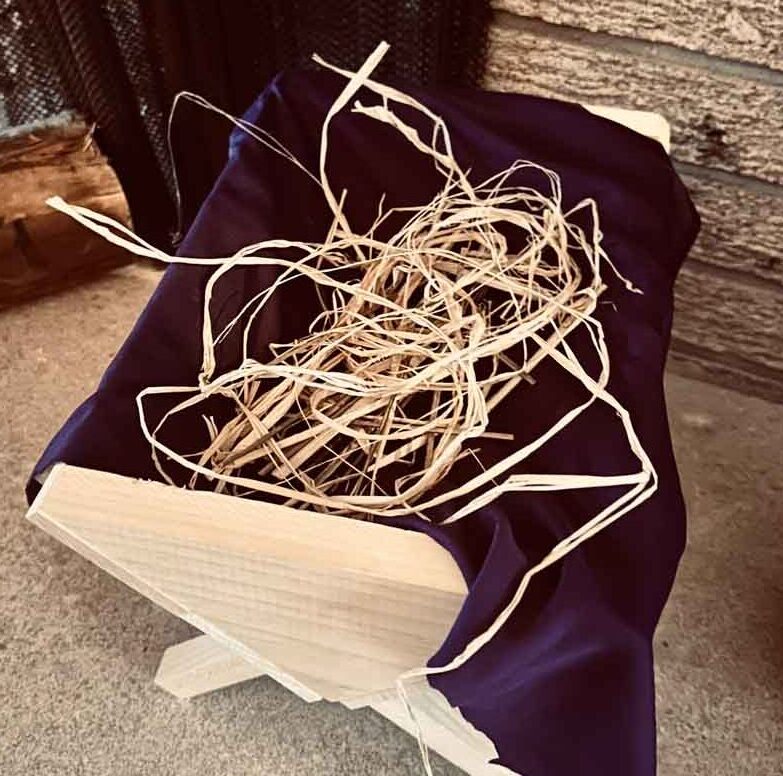
With nativities still out, we may reflect on the wood of the manger in the shadow of the wood of the Cross. How I love how Holy Mother Church provides for and blends these transitions throughout her seasons!
So here are some thoughts and tips for restoring the traditional 40 days of Christmas:
1. Observe a traditional Advent
The question of how to “keep Christmas going” is less complicated when we wait to start Christmas until December 25. After all, our society has no problem celebrating Christmas for months, starting as early as Halloween! Surely, it’s not the length that is the problem, but the time in which we choose to celebrate it.
Traditionally the four weeks of Advent are a time of penance and fasting. We approach it with a similar mindset to Lent, though its special feasts and the mystery of the Incarnation make it less heavy. In our house, we don’t eat sweets except for the feasts of St. Lucy and St. Nicholas. We choose something to fast from in addition and add extra prayers and spiritual reading.
Usually, I give up “extra noise”—podcasts, the news, music, social media, etc. This makes avoiding Christmas films and music until its due time easier! I’ll add a spiritual reading like St. Francis de Sales’s Sermons for Advent.
It is easy to tell it is not Christmas yet in our house because we save the décor until Christmas Eve. Sometimes we get a tree as early as December 17th and add an Ornament for each O Antiphon leading up to Christmas, but it remains unlit and looking quite un-festive until we make hot cocoa and decorate it the day of Christmas Eve—just in time to light for First Vespers!
If keeping most of December like a mini Lent is difficult to stretch your brain around culturally, don’t fret. It appears that struggling to keep the Advent fast is also, well, traditional. Guéranger observes that this difficulty was felt even in the Middle Ages, leading to a loosening on the rules of fasting.
Try taking baby steps back to the liturgy. It does not need to be done all at once. Maybe one year you focus on cutting out the Christmas music and films and the next year adding a fast or moving your tree traditions to Christmas Eve.
Trust in Holy Mother Church and her wisdom! The buildup of anticipation that she models will go a long way in multiplying the graces of the season.
2. Keep up your décor and save Christmas activities for Christmas
Immediately you can see how keeping up the décor and going about normal Christmas activities is done more easily when you’ve only just begun! Keeping a traditional 40 days of Christmas is not a matter of reinventing the wheel or adding a bunch of extra stuff, but of merely moving festivities over to their proper season.
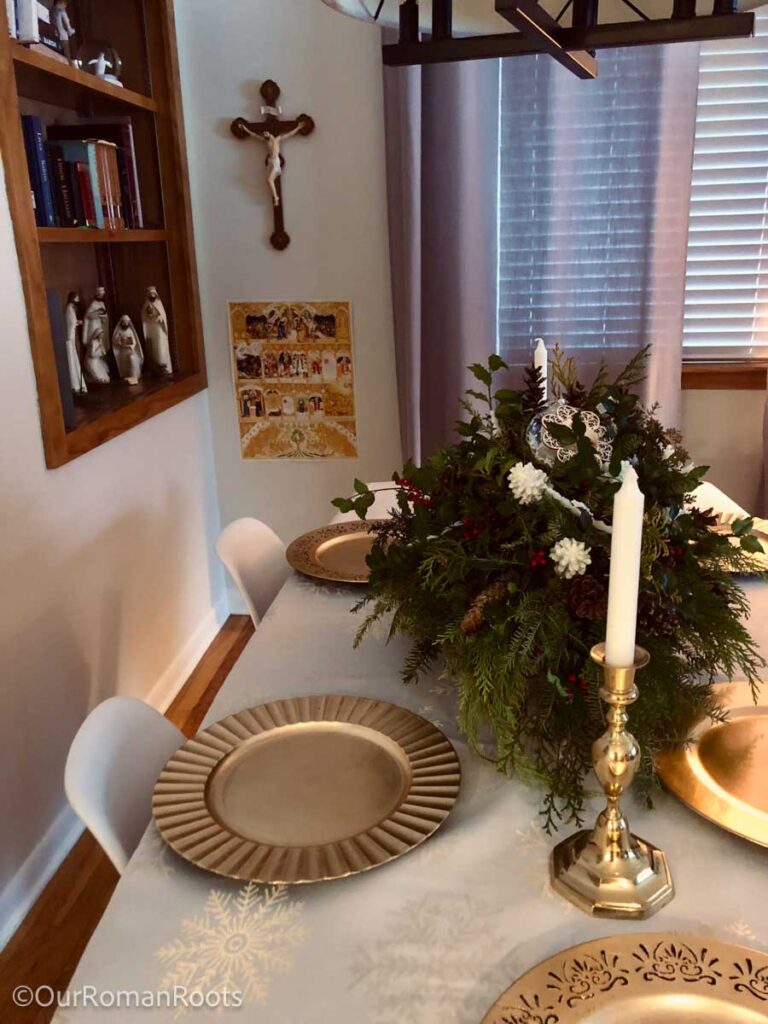
On Christmas Eve, I give the kids their Christmas pajamas and their Christmas outfits for the season. I might add something like Christmas socks. I pull out the Christmas books and keep them in a prominent place all season. We play Christmas music and schedule a couple Christmas movie nights. I even save some cookie baking and things like gingerbread houses for after December 25. We have a special hot cocoa night and the mulled wine abounds.
Simply saving these things for the 40 days is such an easy way to make the season feel festive.
We usually celebrate and open presents from Grandparents in the first couple days. We save our immediate family presents for the Epiphany (January 6), which is a simple way of stretching the gift giving out a little bit. It also gives us time to relax and avoid a little bit of the gift chaos.
After the Epiphany, things slow down. I put away our special Christmas tablecloth and some of the things that are more exhausting to maintain, but we keep up the bulk of our décor including our fresh evergreen tree and continue to listen to Christmas music until February 2.
Now, I understand that some Christmas activities are difficult to keep just by the fact that the rest of society has long forgotten Christmas by the Epiphany. If you get creative, you can usually find some Christmas activities still going on like light displays or museum exhibits. There are also year-round Christmas stores. It would be a fun tradition to go to one mid-January each year and pick out a new ornament.
There are also many opportunities for special family activities that are not necessarily Christmas specific like ice skating or sledding. If you have any more ideas, please share them in the comments!
3. Stay close to the liturgy
What better way to live liturgically than to stay close to the liturgy? The season is full of rich feasts like that of St. John (Dec. 27), when it is customary to get wine blessed.
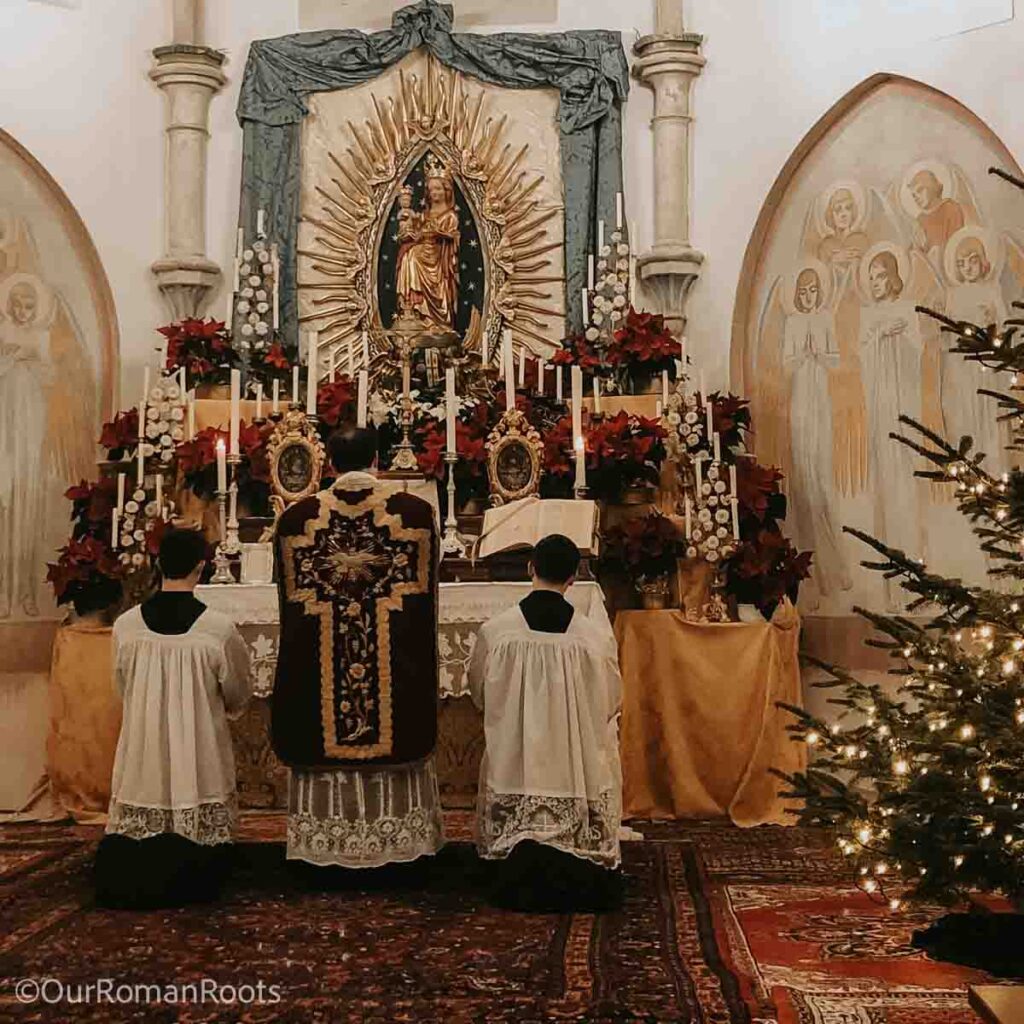
Try celebrating Christmas with daily Mass. If not that, try following along with the traditional readings at home with a good hand missal. You could start each day off with just the propers and an act of spiritual communion—a mere 5 or 10 minutes.
An even simpler way to get the whole family involved would be to attach the daily collect to mealtime prayers. The collect is a very short prayer in which we both unite our petitions with those of the Church and call to mind the feast or season. It gets to the heart of the liturgy for that day in a succinct way and the Church finds it so important that not only is it said in the Mass, but it is prayed several times throughout the day in the Divine Office!
In addition to Mass, Holy Mother Church gives us the Divine Office. Christmas is a beautiful time to start trying to sing some of its prayers with the family. You might try something like what we call a “mini vespers” in our home by adding the Magnificat to your dinnertime prayers. The Magnificat is part of Vespers almost every day, but it is an especially fitting hymn for Christmastide.
Or you could try “mini Compline” by singing the Te Lucis Hymn and/or the Marian Antiphon for the season (Alma Redemptoris Mater).
If the singing intimidates you, you might try reading the hymn from Vespers as a family each night before dinner. You will find in these gems like the hymn for the Feast of the Holy Innocents (Dec. 28), which still makes me tear up.
Another great way to tap into the season through the Divine Office might be looking at the reading from Matins, which often offers insight into the Propers for that day. You can find the text for the Divine Office online.
4. Throw an Epiphany Party
Try throwing a Christmas party—“after” Christmas!
A great way to do this is to throw an Epiphany party. Suitable days for this might be Epiphany Eve (Jan. 5), Epiphany Day (Jan. 6), or the Octave day of the Epiphany (Jan. 13). Usually by these dates, the Christmas whirlwind has slowed down. Friends have returned from visiting family and schedules have cleared.
Invite a priest to offer a traditional Epiphany house blessing at the party. This is an excellent way to share the beauty of our faith’s traditions with guests who might not otherwise experience it.
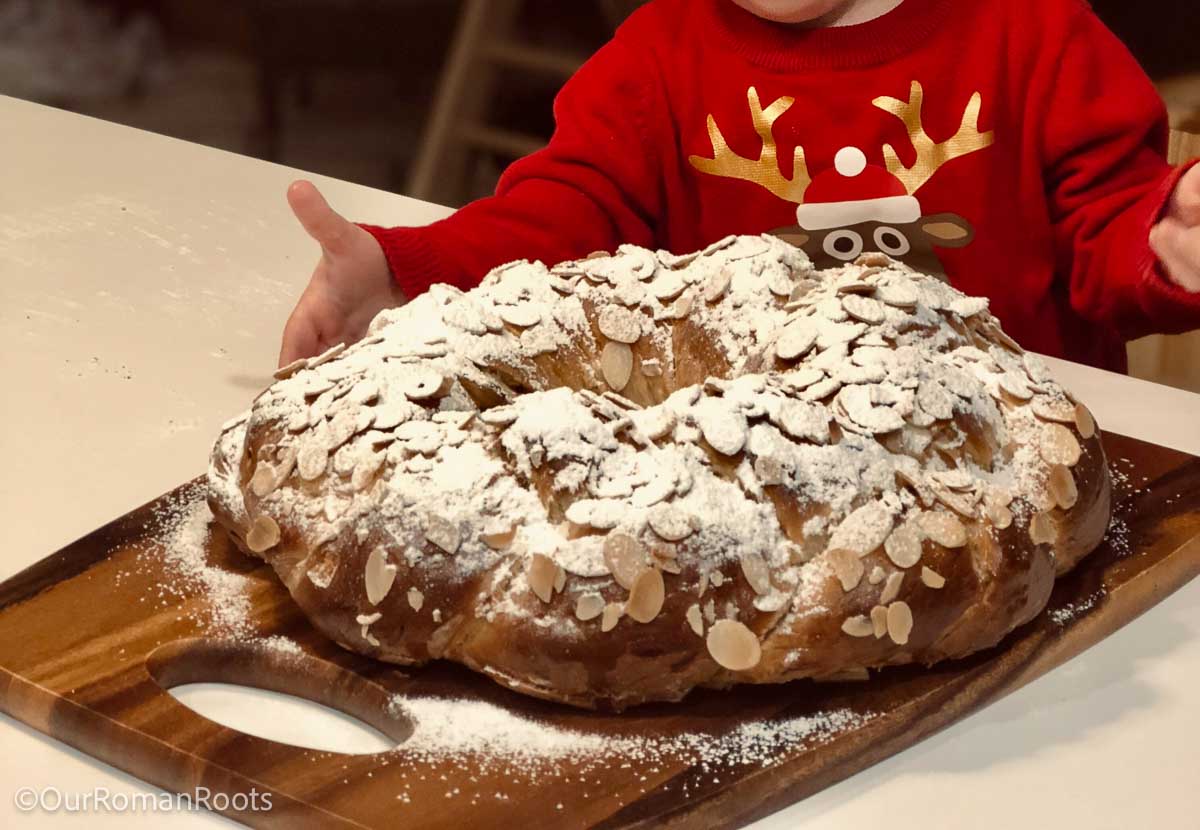
Go festive with the food. Bake a traditional King’s Cake with a small figurine of baby Jesus inside. Whoever gets the piece with baby Jesus gets a prize! We like to make our own version using a traditional Czech recipe for Vánočka (a sweetened, but not too sweet Christmas bread) and forming it into the shape of a crown. I also see many delicious looking recipes for Spanish or French styled ones that are more typical.
You might consider various dishes that represent the far east—Indian, Chinese, Thai, etc. It would be a fun idea to make a pot luck out of it. Not only does this take the pressure off the host during the busy season, but it adds to the spirit of the Feast. Each person or family contributes something of a different culture, representing the Christ Child’s universal kingship and imitating the Wise men who brought gifts from afar.
And definitely sing Christmas Carols, which brings me to the next tip…
5. Sing carols every night or organize a caroling event
There really is something to the line from that silly movie Elf, “The best way to spread Christmas cheer is singing loud for all to hear.”
Historically, carols were an integral part of how the faithful would celebrate Christmas. Of course, singing and making casual music were favored pastimes in general before technology brought us the radio. With the flip of a switch, we have all the music we need, but it is no replacement for the feeling that singing together creates—especially at Christmas.
Not to mention, it is a magical way to inspire awe and pass down the faith to future generations. Music, as we’ve known since the ancients like Plato, has a special way of forming the souls of the young. Singing gives voice to that which is otherwise ineffable—the joy felt in the face of the mystery of the Incarnation.
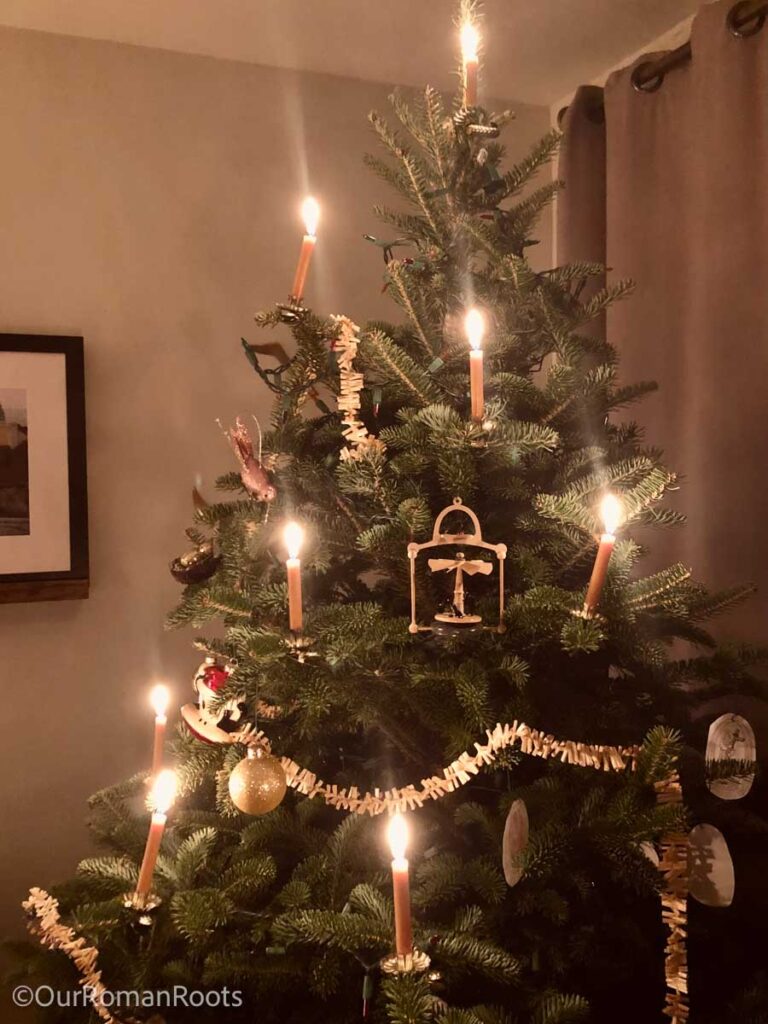
Singing carols is probably my most favorite Christmas tradition. After we sing First Vespers on Christmas Eve, we light the tree, say Merry Christmas for the first time, and raise our voices in song. Pure Christmas wonder.
We try to do this every night after dinner during the Christmas season—even if we only have time to squeak out a carol or two. It can be done quick on a quiet night with just the family or as festive as possible with friends and mulled wine.
No need to have lovely voices or perfect pitch! Please do not let perfection stop you from trying. Christmas carols belong to the musical and musically challenged alike.
And if you are ambitious enough, try spreading the joy to your neighbors. I have such lovely memories of friends standing in the snow holding lanterns and singing outside my door. I can promise you that this special human touch we seldom see today is welcomed—unknowingly yearned for—even by people who think that Christmas is “over.”
Bonus: Spend part of Christmastide at a traditional monastery or apostolate
Experience the liturgical season up close and firsthand by visiting somewhere that offers the traditional Mass and Divine Office. This might be a traditional monastery or an Apostolate of Institute of Christ the King Sovereign Priest.
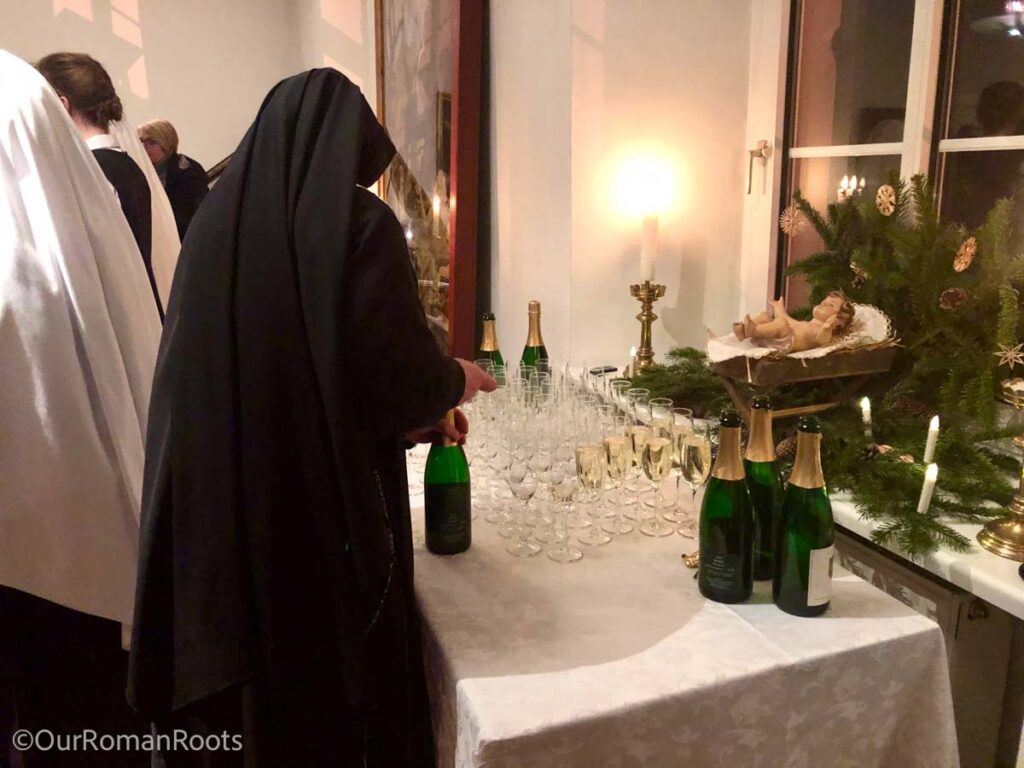
You could make a whole Christmas vacation around it. Monasteries often offer some sort of accommodation. Every few years we spend a couple weeks around Christmas at a monastery in Germany. We attend daily Mass and the Divine Office. It is the coolest thing to watch them switch out the décor for the altar in time for First Vespers on Christmas Eve. We really get a sense of the rhythms of the liturgical season.
Not to mention, it simplifies our Christmas. The focus becomes less on gifts and the sisters cook and clean for us.
This might be harder to come by in the US (if you know of a place please comment below!). There is Clear Creek, but if you are staying as a family you are in charge of your own cooking and cleaning.
Another option would be to get a hotel or short-term rental near an ICKSP apostolate if you are not fortunate to live by one. Contact the parish office to see when the canons might be praying the Divine Office and ask if you can quietly sit in on it.


