The history and meaning of the Paradeisl, a traditional Catholic precursor to the Advent Wreath.
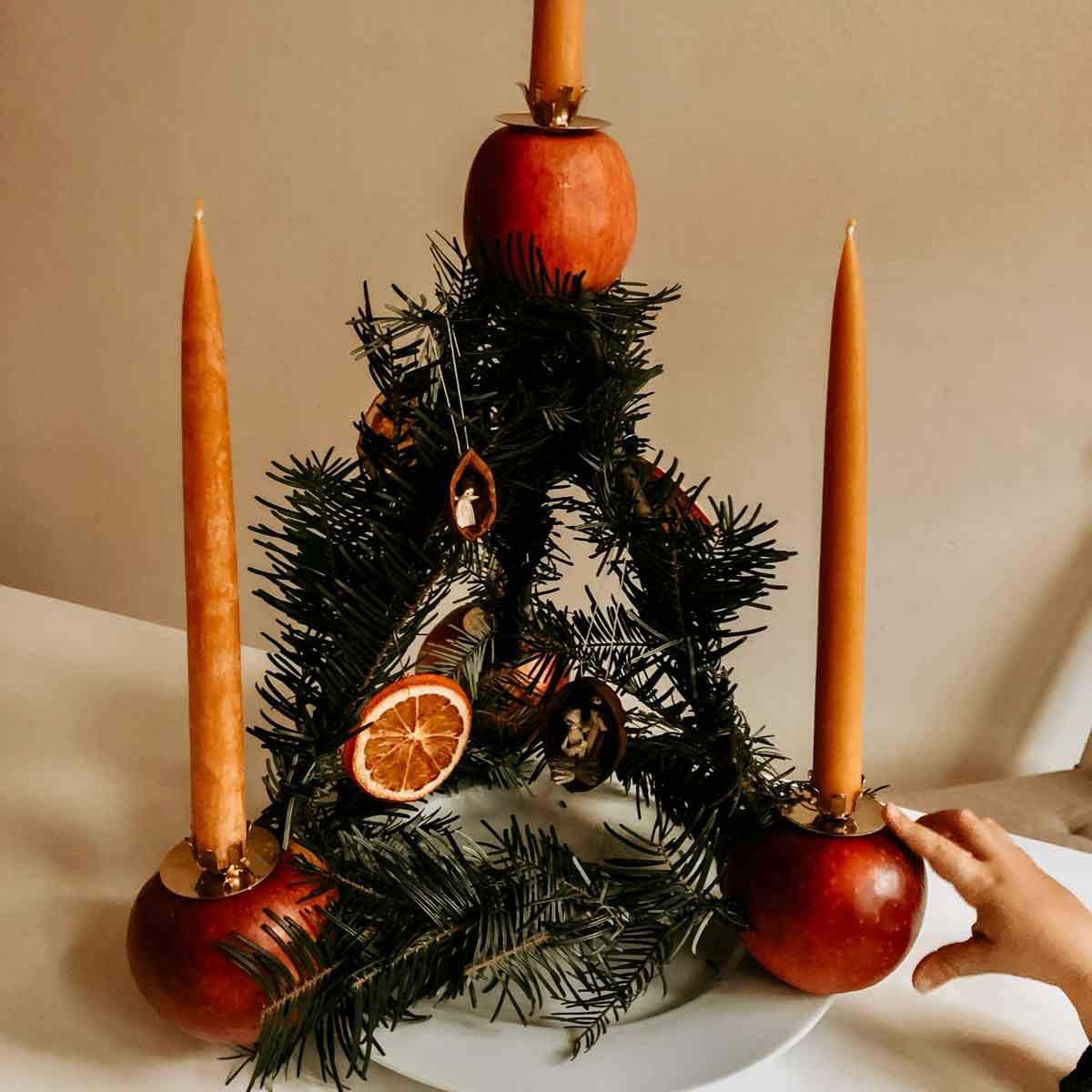
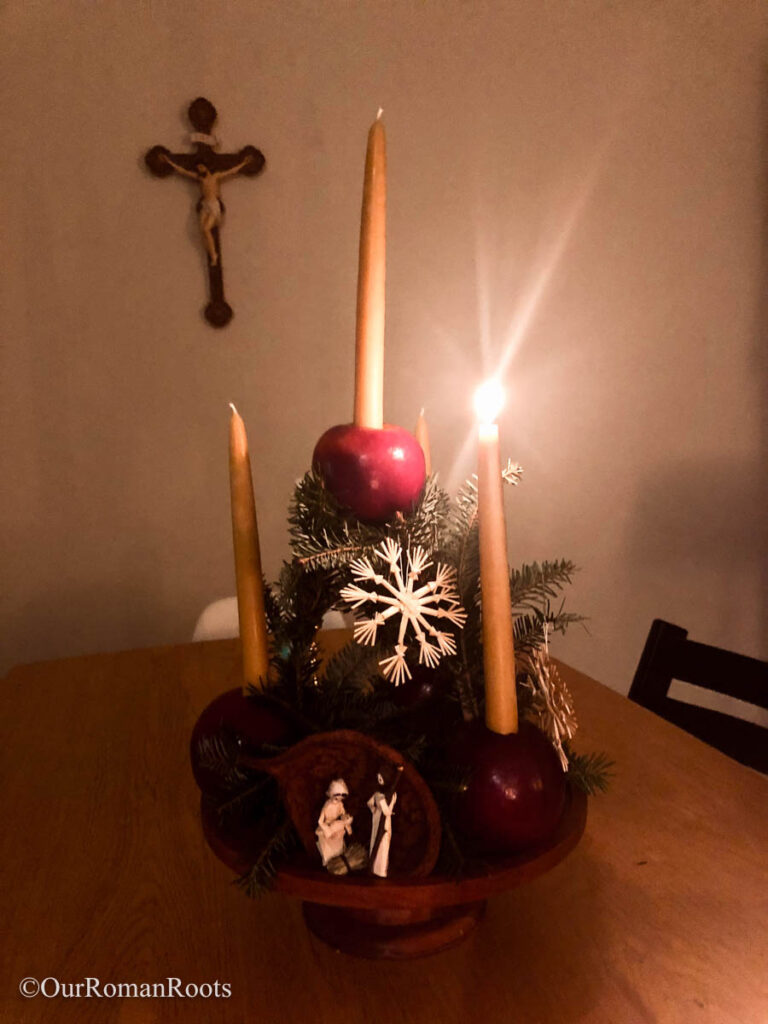
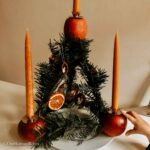
Yet again we’re lighting the dark days of Advent by a Paradeisl. A what? A Paradeisl, from the German word for “paradise,” calling to mind the Fall of Man in the Garden of Eden and the need for redemption. The Paradeisl is a pyramid structure decorated with fresh apples and evergreens designed to hold candles to count down the Sundays of Advent.
It’s an old traditional Catholic predecessor to the Advent wreath, which scholars generally agree was a modern Lutheran invention. Now, don’t get me wrong, we still often make an Advent wreath too, but the Paradeisl has become an especially beloved Advent tradition in our home.
We picked it up from friends in Germany while we were living in Prague. My son looks forward to making it the Friday or Saturday before the first Sunday in Advent. And, I even look forward to the penitential practice of refreshing the rotting apples each Saturday evening just in time for each joyful Sunday. It fits so perfectly into the liturgical rhythm of the week as well as the season of Advent.
We pray First Vespers the Saturday evening before each Sunday and then light the next Sunday’s candle—just as we would an Advent wreath.
What is the History of the Paradeisl?
Scholars give credit to a Lutheran minister, Johann Hinrich Wichern, for being the first to create something like the modern Advent wreath in the mid 19th century. Many admit or hint at similar decorations already in use by Christians before Wichern’s version, but the evidence of these decorations is difficult to trace. The novelty of the Lutheran minister’s version is said to be the idea of “lighting an increasing number of candles as Christmas approached.”[1]
However, what is little known—or conveniently never mentioned—is that there already was a Catholic tradition of progressively lighting candles to mark the days through the dark nights of Advent. This tradition was the Bavarian Paradeisl.
It is hard to say how far back the Paradeisl predates Wichern’s invention. We can trace the Paradeisl’s origins to medieval Paradise Plays. The first record of these plays dates back to the 12th century. It is harder to say when the Paradeisl itself was created and entered people’s homes because it was a private commoner practice, which is to say, it was probably not considered important enough to record. However, we do know that variants can be found as early as at least the 15th century.
A Paradise Play was a medieval Advent tradition of dramatizing the salvation story. The scenes depict the fall of the angels, the fall of man in Paradise, the promise of redemption, and the fulfilment of this promise in a tiny baby through the mystery of the Incarnation.
By the High Middle Ages these plays would span days and their props and sets would take over entire marketplaces. They were a pretty big deal, and naturally, would spill over into people’s homes. Thus, the creation of the Paradeisl, one’s own personal prop to reflect the story of salvation.
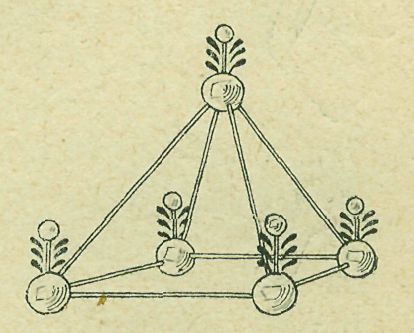
Variations of the Paradeisl can be found in the folk traditions of the Bavarian and Czech Lands. The Klausenbaum is named for St. Nicholas, whose feast day falls during Advent. The Klausenbaum might include depictions of the saint, such as a picture, a straw ornament, or cookies bearing his resemblance. I’ve seen variations that are indistinguishable from the Paradeisl, built from only four apples, and still more that consist of multiple levels or are more boxy instead of triangular. One Czech sketch depicts a wider pyramid with a square base using five apples.
There is also the Silesian Putzapfel, which is only a single apple elevated by sticks stuck into the bottom. It is topped with a candle and greenery.
Admittedly, not all these variations functioned as a timepiece as the Paradeisl or Advent Wreath do. And so, the Paradeisl is also compared to the Christmas tree—something you would light and sing carols around during the Christmas season. I’ve seen mention that poor families would wait until Christmas Eve to light their Paradeisl, presumably so that they could make the materials last through the Christmas season.
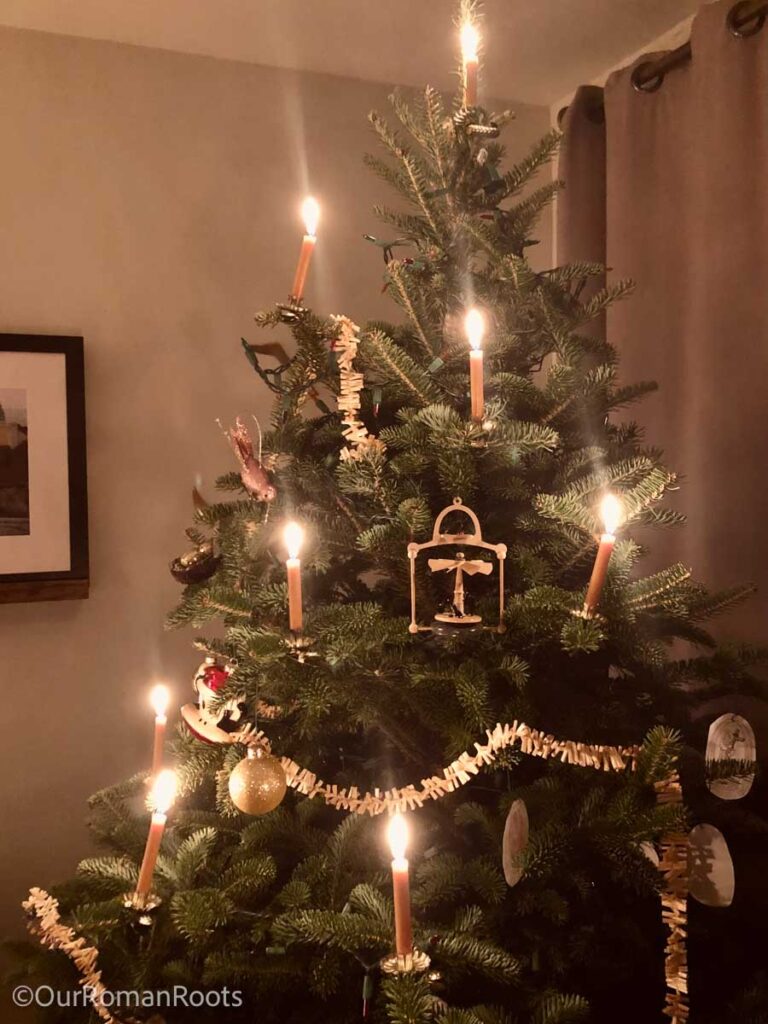
The Paradeisl was still a strong Advent tradition among Bavarian Catholics in the early 20th century. One Munich newspaper reported in 1933 that the paradeisl could be found in almost every “pre-Christmas room” (vorweihnachtlichen Stube)—that is, until the protestant Advent wreath began to generally replace it.
The cultural significance of this is largely lost on American Catholics. Again, we do still use an Advent wreath in our home. I am not here to be the Advent wreath grinch, but I think it’s worth considering why the Paradeisl might be a particularly traditional Catholic symbol over the Advent wreath, at least in Catholic Bavaria.
Consider the apparent Protestant origins of the Advent wreath and its widespread secular commercialization in Europe (you really don’t see the extent of this in the U.S.). You can find them at the markets and grocery stores in all forms and colors and sizes bearing little resemblance to the penitential or spiritual aspect of the season. Indeed, they are part of the secular, even atheistic, culture. And then consider that the Paradeisl was popular in Catholic Bavaria until the Advent wreath sort of, well… took over.
And so, you can see how my heart swells with a bit of distinctively Catholic zeal whenever we make a Paradeisl.
But, I love it even more for what it’s strange medieval construction symbolizes…
What is the symbolic meaning of the Paradeisl?
Pyramid structure
The Paradeisl forms a tetrahedrom with four equilateral triangles. Each triangle represents the Holy Trinity—God the father, God the Son, and God the Holy Ghost in three equal sides and angles.
Moreover, the natural perfection of the pyramid shape reflects divine perfection as the four triangles are three and one, forming a unit like the trinity. The mystery of the Holy Trinity consists in Three Persons and four relations—as described, for example, by St. Thomas Aquinas and upheld by the Council of Florence (1338–1445).
Of course, the mystery of the Holy Trinity comes to a climax in a special way as we approach the Christmas season. God the Father sends the Holy Ghost so that the Word may be made flesh and dwell among us in the mystery of the Incarnation.
Evergreens and the Tree like-ness
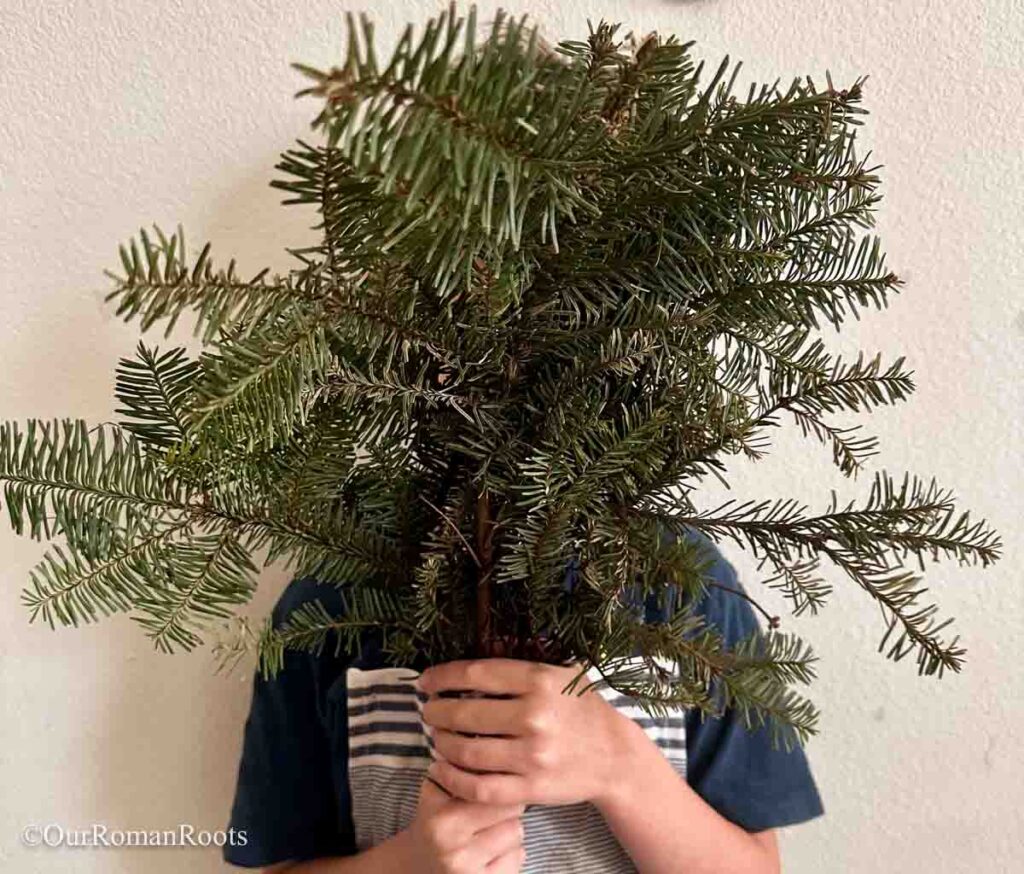
The pyramid structure also lends itself to a tree-like quality as the Paradeisl is topped with evergreens and shaped like a tree. These evergreens are more prominent when they are wrapped entirely around the sticks of the pyramid. But they also might be less prominent as when they are delicately placed in just the tops of the apples.
In one sense, the tree-like quality represents the Tree of Knowledge in paradise. This is the setting where Man’s part in the drama of salvation begins to unfold. It is a reminder of that paradise from which we have been expelled and the feelings of longing and homelessness we feel in this world.
The tree-like quality not only calls to mind our expulsion in this valley of tears, but also hints at the coming of our Redeemer, the Tree of Life Himself and the Cross he will bear for our redemption. And so, at once, the tree calls to mind both the need for a redeemer and the promise of its fulfilment.
The evergreens further reflect the longing for the greenery of lost paradise as well as the promise of spring time and new life. In older times, boxwoods specifically were thought to ward off demons and certain herbs might have been added for this purpose as well.
Apples
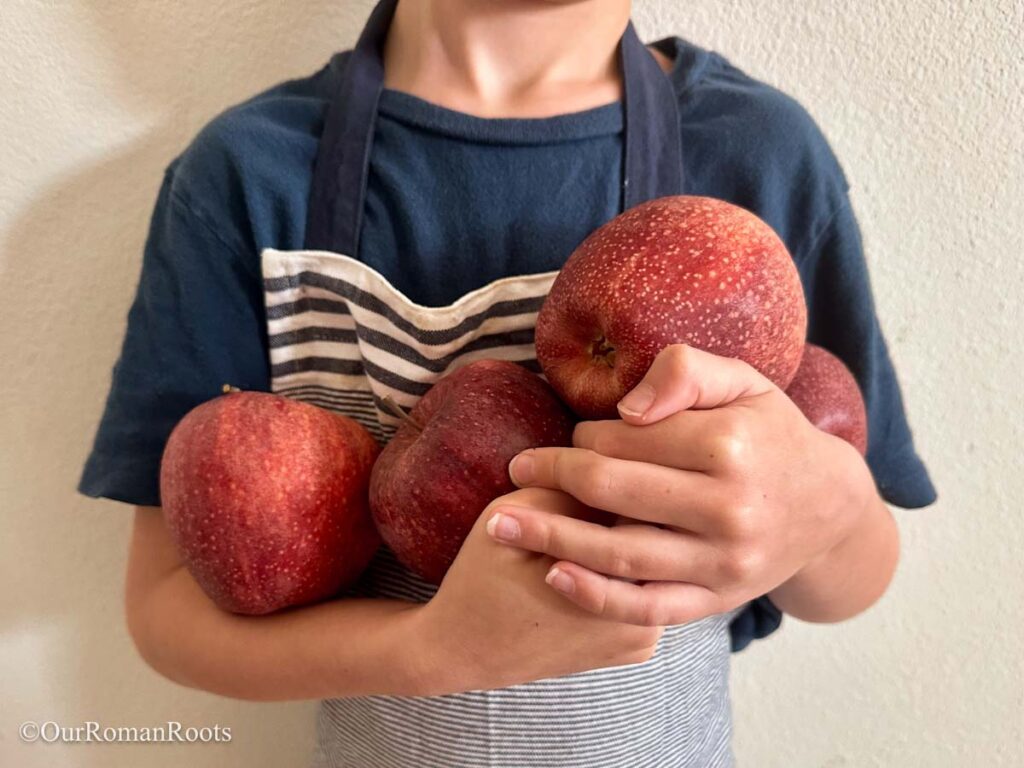
The apples more directly represent original sin and the need for redemption. As we know from Genesis, Eve took from the Tree of Knowledge and Gave it to Adam.
I love having this at the front and center of our Advent season that culminates in Christmas Eve. It seems largely forgotten today that Christmas Eve is the Feast of Sts. Adam and Eve. On the night we celebrate the birth of our Savior we also celebrate the first sinners on whose account we need to be saved in the first place. They are not models of scorn but of repentance. How great is God’s mercy!
I will put enmities between thee and the woman, and thy seed and her seed: she shall crush thy head, and thou shalt lie in wait for her heel.
Genesis 3:15
On this Holy Night we call to mind the sad story of our first parents and the promise to make things anew. We have Eve and the New Eve. Eve took of the forbidden fruit, but we see the fruit of Mary’s Fiat. Long descended from Adam, we have the New Adam. Accordingly, art dating back to at least the 15th century depicts Mary or the infant Jesus holding an apple.
Apples have long been symbolic of the Fall and appear in old world decor during the Advent and Christmas seasons. I see Apples especially in Europe featured in Nativity sets or paintings, most often in the hands of the infant Jesus. They are also used for Christmas décor—placed decoratively on tables or fake ones made into ornaments. I’ve heard it said that this is where we get Christmas tree baubles from.
Candles
In a very practical sense, the candles represent each Sunday of Advent and are to be progressively lit each Sunday just as one would an Advent wreath.
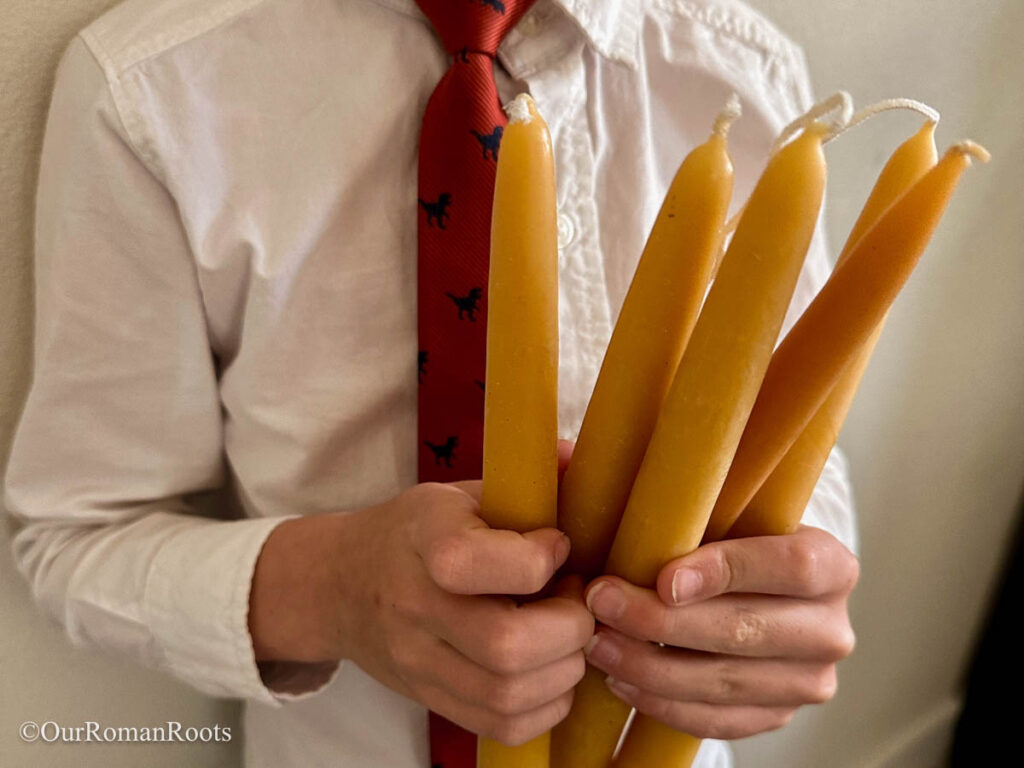
In a more symbolic sense, the candles represent Christ as the light of the world. He has indeed already come to us, which as Guéranger says, the church does not forget even in her sighs. Thus, we have His light. Yet, we still mournfully anticipate His coming and so we slowly light the candles week by week.
A natural beeswax candle is fitting for this reason as beeswax is used in sanctuary and devotional candles to represent the purity of Christ. The natural color is also fitting because it is held to be a penitential color and Advent is a penitential season. Other traditional colors used for the candles might be white, also symbolic of purity, or red, which was probably purely decorative but I like to think of it as an extension of the apple and thus further symbolic of the apple.
I’ve seen mention of using purple and rose, the Church’s liturgical colors for the season, as is popular for modern Advent wreaths. These colors, however, reflect a more recent influence of the American Advent wreath and are not traditional to the Paradeisl.
Traditional ornamentation
There are several ways to decorate the Paradeisl. I’ve seen some use less greenery and instead carve beautiful designs into sticks of walnut.
Ornamentation typically utilizes natural materials and is not necessarily symbolic though reflects the folk spirit when they are made from nature and by hand. Dried oranges, nuts, and even cookies and treats might be used.
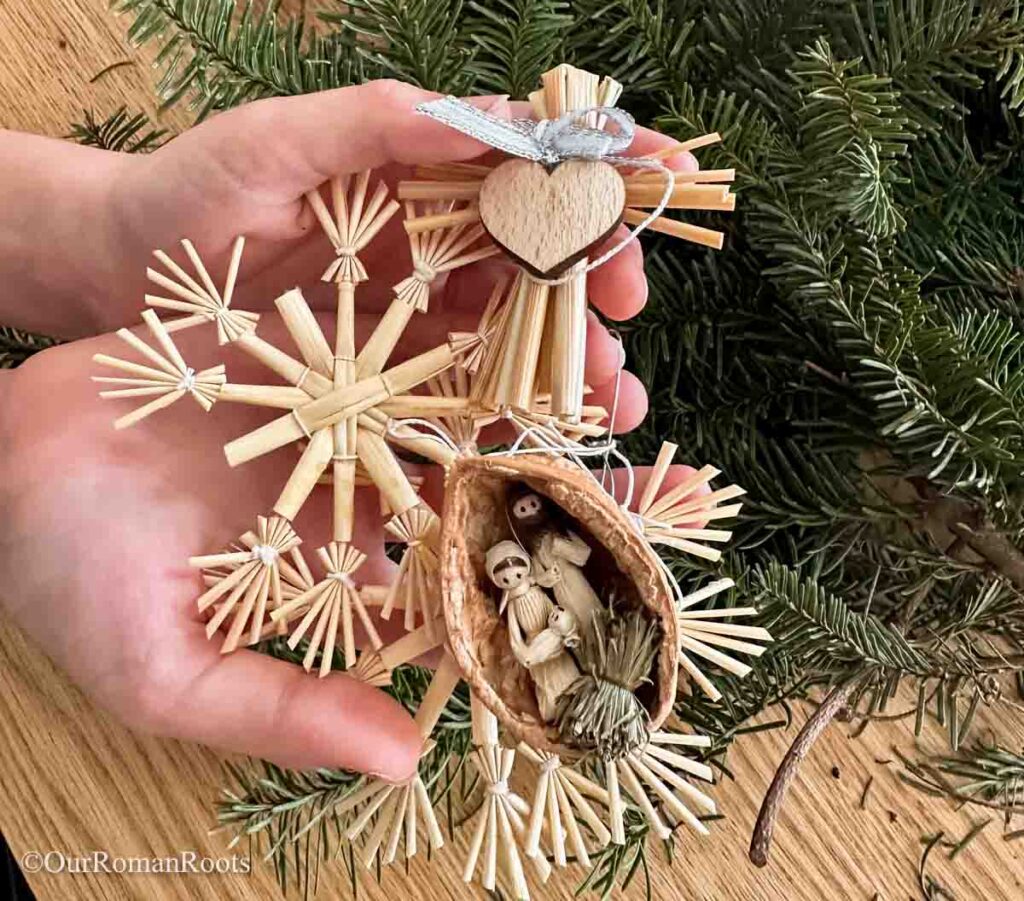
Straw ornaments are common. These might be decorative stars or snowflakes or representations of Adam and Eve. One tradition I’ve seen is placing Adam and Eve in the center during Advent and then replacing them with figures of the Holy Family on Christmas.
Another tradition I’ve seen are walnuts with tiny images of the holy family or baby Jesus inside of them. They are kept hidden with the half shell facing in until they are turned out and revealed in time for Christmas.
How to use a Paradeisl?
Like the Advent wreath, it is not strictly speaking a liturgical practice. You will not find a blessing for it in the Rituale Romanum or a formalized set of readings or prayers. It is more of a domestic decoration, something sprung from the home to meet the liturgical year. As such it inspires piety and devotion that goes with the wonder and awe of the season.
Traditionally, I’ve heard that it was lit for dinner or after and used as a piece to sing Advent hymns and carols around. We like to sing the Divine Office around it too—especially Vespers or the O Antiphons in the last days leading up to Christmas.
Instructions for how to make a traditional Catholic precursor to the Advent wreath from Bavaria. It is constructed with natural materials in the spirit of folk traditions and used to mark time through the dark days of Advent. The apples and tree-like structure remind us of the Fall of Man and the Promise of Redemption. Thus the name "Paradeisl" or "Little Paradise."
Prep Time1 hourhr
Author: OurRomanRoots
Cost: $20-50
Equipment
Floral Wire
Garden Shears
Manual Pencil Sharpener
Materials
Decorative BaseExamples include a plate, cake stand, or sturdy cardboard wrapped in decorative paper
6DowelsI’ve also used sticks from the backyard, chopsticks, and bamboo skewers
Evergreen clippings from boxwoods or pines
4Red apples
412-inchtaper candlesticksI prefer beeswax in natural, red, or white
Ornamentation such as straw ornaments or dried oranges
Instructions
Prepare the Paradeisl Structure
Trim the dowels or sticks to fit the size plate or cardboard that you wish to use as a base. I typically have 3 8.5 inch ones for the base and 3 9.5 inch ones for the top.
Sharpen the sticks on each end with a manual pencil sharpener.
Clip off the pretty pieces of the evergreen clippings and collect in a pile. I like to use the tri-points but I will use other odds and ends to make make clippings go further.
Use the floral wire to attach evergreens to the sticks. Begin at one end of each stick and wrap the wire around each clipping one or two at a time until you reach the other end. Be sure to leave a little space on each end of the stick to allow you to insert it into the apple.
Assemble the Paradeisl into a Pyramid
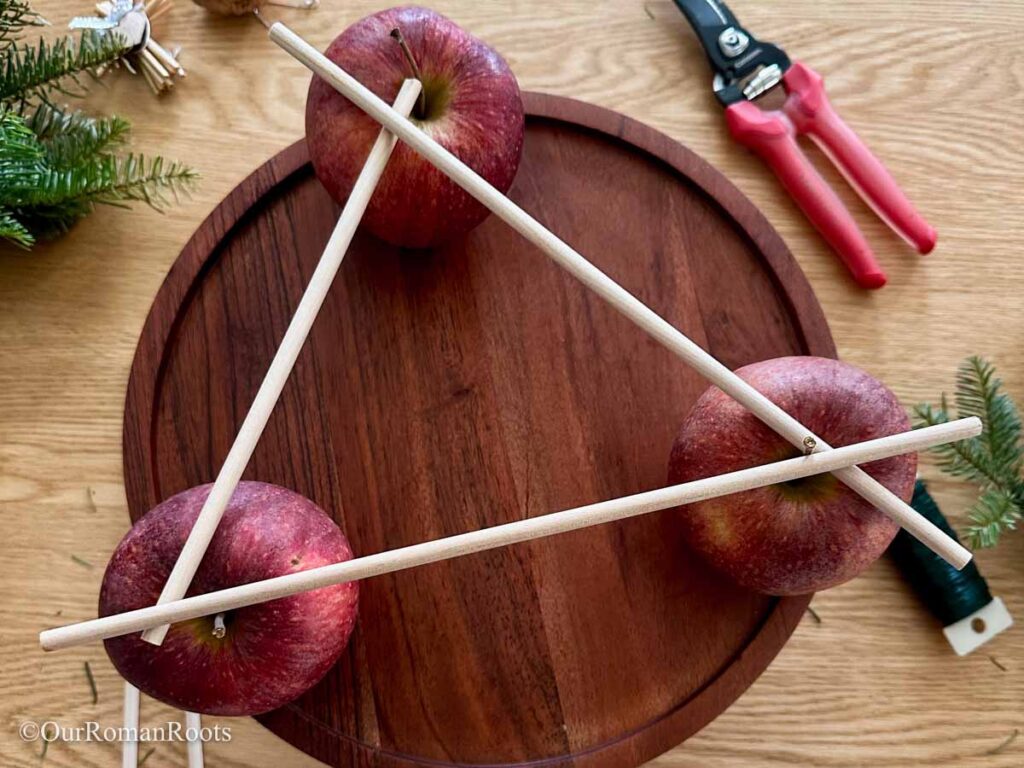
Place the 3 shorter sticks (8.5 inches each in my example) in a triangle shape on your decorative plate/base.
Place one apple at each corner of the triangle. Gently insert the end of each stick into the apples to form a triangle.
Form the top of the pyramid shape with the longer sticks (9.5 inches each in my example). Gently insert one end of each stick into the three corner apples. Insert the remaining ends into the fourth apple at the top of the pyramid.
Add the candles and decorate
Attach the candles to the apples. You can buy special floral candle holders that are used to attach tapers to wreaths, but I find toothpicks work just as well. Insert one end of the toothpick into the bottom of the candle and the other end into the top of the apple.
Decorate with dried oranges, nuts, gingerbread cookies, or straw ornaments.
Consider adding a depiction of the holy family without the infant Jesus (until Christmas, of course) or of Sts. Adam and Eve.
[1] Mosteller, Angie. Christmas, Celebrating the Christian History of Classic Symbols, Songs and Stories. 2010, 167.
5 Tips for keeping the 12 Days of Christmas and Beyond In American culture, Christmas seems to be over December 26. The lights come down, people stop saying “Merry Christmas!”, and the trees find their way to the curb. The bleak midwinter of January hits but none of the Christmas cheer promised in songs of…
5 untraditional tidbits about the Advent wreath and why I still make one As a teenager, I remember a Lutheran friend sharing an Advent wreath she had made at church. This surprised me, as I had known it to be a longstanding Catholic tradition. “Good for them,” I thought. Only some years later did I…
I have compiled the following list of common excuses I hear about not attending the Traditional Latin Mass (TLM). It is meant for those who are feeling overwhelmed or not quite sure they want to drive extra far for Mass every Sunday. It is not an exhaustive list, nor are my rebuttals. I don’t expect…
Easter is coming. We look forward to announcing that joyful battle cry of the Church Militant, “He is Risen!” But before we may taste this joy, we must taste the bitter waters of Good Friday. We must reflect on the Via Dolorosa and the Death that shook the world and blotted out the sun. G.K….
Estote ergo prudentes sicut serpentes, et simplices sicut columbæ. Be ye therefore prudent (prudentes) as serpents and simple as doves. Matthew 10:16 Prudence is so often used as an excuse for cowardice, that we have come to mistake it for timidity or cautiousness. When we find ourselves between a rock and a hard place, it…
“…et erat scriptum hebraice graece et latine”“…and it was written in Hebrew, in Greek, and in Latin.” (John 19:20) While Latin might prove useful for liturgical use in innumerable ways, it is a sacred language first and foremost because it was chosen by the hand of Divine Providence. As Msgr. Nikolaus Gihr wrote, “the Latin language…